
The Roman Globalist Church

As Christians worldwide celebrated their most significant holiday, their most recognizable figure delivered a distinctly secular message. 

On Easter Sunday, the Vatican released a letter Pope Francis wrote to Catholic organizations in South America. Francis wrote that the coronavirus pandemic “might be a good time to consider a universal basic wage” that would enable the poor to enjoy “the benefits of globalism.” 

Such a measure, Francis wrote, “would ensure and concretely achieve the ideal, at once so human and so Christian, of no worker without rights.” 

Toward the end of his letter, Francis hoped the pandemic would generate “a humanist and ecological conversion that puts an end to the idolatry of money, and places human life and dignity at the center.” 

Nowhere in his letter did Francis mention Jesus Christ. 

The letter conclusively proves that Francis is transforming the Catholic Church into another non-governmental organization. In the process, he is destroying the church’s identity and credibility. 

Francis’ activism reflects and culminates the Vatican’s embrace of humanist utopianism, which Front Page Magazine briefly addressed last year in “They Died For ‘Dialogue’?” That article traced the Holy See’s policy of appeasing Islam and China to the radical globalism adopted at the Second Vatican Council, which met from 1962 to 1965. 

A pastoral document written on politics and economics during the council stated that “there must be made available to all men everything necessary for leading a life truly human, such as food, clothing, and shelter. … Hence, the social order and its development must invariably work to the benefit of the human person.” 

In 1967, Pope Paul VI called for international agencies to create “a full-bodied humanism,” he wrote, by managing the world’s economic and political development: 

Such international collaboration among the nations of the world certainly calls for institutions that will promote, coordinate and direct it, until a new juridical order is firmly established and fully ratified. We give willing and wholehearted support to those public organizations that have already joined in promoting the development of nations, and We ardently hope that they will enjoy ever growing authority.

In 2009, Pope Benedict XVI took that concept to its logical conclusion ​by advocating that the United Nations direct both international and domestic​ economic policies:

In the face of the unrelenting growth of global interdependence, there is a strongly felt need…

for a reform of the United Nations…and, likewise, of economic institutions and international finance, so that the concept of the family of nations can acquire real teeth…. 

To manage the global economy…to bring about integral and timely disarmament, food security and peace; to guarantee the protection of the environment and to regulate migration: for all this, there is urgent need of a true world political authority…

This authority, Benedict wrote, must “seek to establish the common good” and “have the authority to ensure compliance with its decisions from all parties, and also with the coordinated measures adopted in various international forums.” 

The ultimate purpose, Benedict wrote, would be to design a “directed” global economy that would “open up the unprecedented possibility of large-scale redistribution of wealth on a world-wide scale” – – including “a worldwide redistribution of energy resources, so that countries lacking those resources can have access to them.” 

In promoting such an authority, Benedict subtly redefined the Catholic Church’s primary role from proclaiming the Gospel to ensuring economic benefits for all — or, at least, redefining the Gospel in materialist terms. Benedict even presumed that global economic management through a “true world political authority” can achieve spiritual harmony. 

When animated by charity, commitment to the common good … has a place within the testimony of divine charity that paves the way for eternity through temporal action. Man’s earthly activity, when inspired and sustained by charity, contributes to the building of the universal city of God, which is the goal of the history of the human family.

Like his predecessors, Francis believes globalism is pivotal. In an August interview with the Italian newspaper La Stampa​​, Francis criticized nationalist movements threatening the European Union: 

Europe cannot and must not break apart. It is a historical, cultural, as well as geographical, unity. Never forget that ‘the whole is greater than the parts.’ Globalization, unity, should not be conceived as a sphere but as a polyhedron. Each people retains its identity in unity with others.

Francis’ bishops promote the new prime directive. “They Died For ‘Dialogue’?” mentions the praise Bishop Marcelo Sanchez Sorondo, the chancellor of the Pontifical Council for Sciences and Social Sciences, gave China in February 2018:

Right now, those who are implementing the Church’s social doctrine the best are the Chinese.

They search for the common good and subordinate everything to the general welfare.

Sorondo particularly praised China’s implementation of “Laudato Si,” Francis’ environmental encyclical, for “defending the dignity of the person” and “assuming a moral leadership that others have left,” a criticism of the United States’ withdrawal from the Paris Agreement on carbon-dioxide emissions. 

Sorondo issued his praise despite the fact that China ranks among the world’s worst air polluters, performs between 10 million and 23 million abortions a year — many of them forced by the government — and persecutes Christians who worship outside of state-approved churches. 

In June 2018, Cardinal Pietro Parolin became the first official from the Holy See to attend the Bilderberg Meetings, where international figures from business, finance, government, communications and academia gathered to discuss such topics as political populism, free trade and economic inequality. Eighteen months earlier, Parolin had addressed the World Economic Forum in Davos, Switzerland. 

Parolin — the Vatican’s second-most powerful figure as its secretary of state — received an invitation from the Bilderberg organizers, who insisted upon his presence.

Nearly three months later, Chicago Cardinal Blase Cupich vividly illustrated the papacy’s priorities. Immediately after Archbishop Carlo Maria Vigano alleged that Francis protected and promoted sexual predators among the bishops, Cupich performed his best imitation of Marie Antoinette. 

“The Pope has a bigger agenda,” Cupich told Chicago’s WMAQ-TV. “He’s got to get on with other things: talking about the environment, protecting migrants and carrying on the work of the Church. We’re not going to go down a rabbit hole on this.” 

Cupich repeated that theme the next day at Mundelein Seminary in suburban Chicago: “We have a bigger agenda than to be distracted by all of this,” Cupich told the seminarians, one of whom spoke anonymously to the Chicago Sun-Times about the archbishop’s address. The Sun-Times published the story after receiving confirmation from other sources, including several seminarians.

If Catholic prelates are willing to disregard the victimization of the innocent, nobody should expect them to uphold the church’s historic opposition to abortion and contraception.

In February, one month before California‘s primary, San Diego Bishop Robert McElroy issued voting guidelines for Catholics in his diocese. But McElroy did more than reiterate support for Francis’ positions on environmentalism and immigration. He essentially stated that those positions held greater significance than the church’s stance against abortion and contraception.

While conceding that abortion was “intrinsically evil,” McElroy criticized the idea that “candidates who seek laws opposing intrinsically evil actions automatically have a​ primary claim to political support in the Catholic conscience.”

“The problem with this approach is that while the criterion of intrinsic evil identifies specific human acts that can never be justified, this criterion is not a measure of the relative gravity of the evil in particular human or political actions,” McElroy wrote. “Telling a lie is intrinsically evil, while escalating a nuclear arms race is not. But it is wrongheaded to propose that telling a lie to constituents should count more in the calculus of faithful voting than a candidate’s plans to initiate a destabilizing nuclear weapons program.”

Similarly, contraception is intrinsically evil in Catholic moral theology, while actions which destroy the environment generally are not. But it is a far greater moral evil for our​ country to abandon the Paris Climate Accord than to provide contraceptives in federal health centers.​ (emphasis added)

Perhaps no better example of the Vatican’s embrace of humanist globalism exists than the presence of economist Jeffrey Sachs as a papal advisor. Sachs, who drafted the UN’s Sustainable Development Goals, supports abortion as an integral part of population control. Nevertheless, he participates frequently in Vatican conferences on sustainability.

So why would Francis have Sachs as an advisor? Consider these comments the economist made to the National Catholic Register ​​after one such conference in February:

Asked whether by the Church’s teaching on human dignity he meant respect for life from conception to natural death, Sachs replied: ‘I mean everybody’s economic needs should be met, that people should have the dignity of work, that the poor should be helped, that this is about the core ideas of human well-being.’

Asked if by helping the poor he meant wealth creation, he said: ‘Jesus said, “He who feeds the least among me, feeds me.” He was talking about helping the poor. When Aristotle talks about politics or the common good, he’s talking about a society in which people afforded dignity.’

‘We know why our current system leads to massive inequalities, leaving billions of people behind,’ he said, ‘and so this is about public policy, about individual ethics, social organization. It’s about our attitudes towards others.’

When questioned by Pontius Pilate, Jesus said that his kingdom was not of this world. Yet as Sachs demonstrates, Catholicism is trying to gain the whole world by being like the world. By doing so, the church is losing its own soul.

https://www.frontpagemag.com/fpm/2020/05/roman-globalist-church-joseph-hippolito/
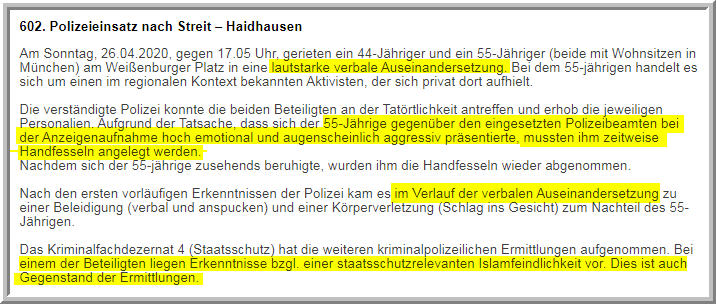
Muslim spits on a critic of Islam, German police accuses the victim of “Islamophobia relevant to state security”

Bild

That’ s far out: After Michael Stürzenberger was spat on and punched in the face by a Muslim, the @PolizeiMuenchen is working hard on a justification for the Islamist warrior of God and is handcuffing the victim as a precaution.But no, @PolizeiMuenchen. There was no “verbal altercation”. It was a one-sided attack by the Muslim himself by spitting and punching. Just because a critic of Islam was sitting on a bench in silence.And then the police handcuffed this victim.

Why Israel fought the virus much better than the West

by Giulio Meotti

In several countries, nursing homes are being turned into dying homes. We condemned thousands of elderly people to the most atrocious death, in extreme solitude, deprived of their loved ones, without holding the hands of their children, without speaking to a priest, even brought to the crematorium en masse, without even the slightest funeral ritual being allowed.It is a form of anthropological transgression that clashes intimately with the conscience of Western civilization.

Half of the deaths from Covid-19 in Europe have been in nursing homes. It is not a coincidence. We deliberately sacrificed these elderly in a form of social Darwinism.

If our conscience will resist  this terrible temptation, the West might have some future. Otherwise, it will be transformed forever.

The Covid-19 epidemic destroyed the anthropological, social and cultural illusions on which we Westerners have lived for half a century. Armed with hedonistic rhetoric, we thought we were safe, that we even had abolished death. This disease destroys those illusions and our false consciousness. It forces us to return to the truth of the human condition. Western man now knows that death exists!

We in the West dreamed of transhumanism, gender-free, abolition of borders, digitalization of the world; the very words “border”, “nation”, “people”, “identity”, “family”, were taboo. Now we rediscover all of these are crucial to fight the disease.

This crisis has served to remind us that the family is the fundamental and basic framework that allows life to flourish and unfold, especially when existence is threatened with being pulverized.

When danger came on a collective level, the state was unable to protect us and we retreated into our own family. 

It was the crisis of Western man, who wanted to be absolutely the master of himself, free from the bonds of belonging, without a country, without religion, without civilization, without gender. Postmodern nihilism is now decomposing before our eyes.

After years of talking about “Uberization”, the Western man suddenly felt the need for a home, a place to retreat, a fortress, if necessary. The Western utopia where individuals were at home everywhere is dead.

Our cultural imagination was full of Hollywood-type disasters. But when real danger knocked on the door, we had become unable to see and hear it. We lacked the very possibility of realizing an existential danger.

That is why Israel coped with this virus much better than the West. People, borders, family, religion, identity and danger are an integral part of Israel’s identity. 

http://www.israelnationalnews.com/Articles/Article.aspx/25636

What took so long? Hezbollah ban in Germany was long overdue

After years of pressure from the US (both the Obama and Trump administrations) and the Israeli government, Germany’s interior minister on Thursday banned all activities of the Lebanese terrorist movement Hezbollah within the federal republic’s territory. “That was overdue,” wrote Frank Jansen about the ban in his Tagesspiegelnewspaper commentary. Jansen is one of Ger many’s leading national security reporters.

German Interior Minister Horst Seehofer declared that Hezbollah’s activities “violate criminal law and the organization opposes the concept of international understanding.”In other words, Germany’s government could have banned Hezbollahdecades ago.Chancellor Angela Merkel’s administration declined and furnished a series of bogus arguments. Germany linked a ban to the Israel-Palestinian peace process in 2018. Last year, after the UK outlawed Hezbollah, Germany’s deputy foreign minister, Niels Annen, said when asked about a ban: “Hezbollah is however also a relevant factor in Lebanese society and an integral part of the country’s complex domestic-policy make-up. It has seats in Parliament and is part of the Government.”A veteran German journalist, who has written extensively about Iranian regime-sponsored terrorism and intelligence agencies in the federal republic, told me Germany cut a deal with Hezbollah after the organization’s 1992 terrorism attack in a West Berlin restaurant.A joint Hezbollah-Iran operation assassinated three Iranian-Kurdish leaders and their translator in the Greek restaurant Mykonos. The quid pro quo, according to the journalist, was: Hezbollah and Iran discontinued terrorism operations on German soil in exchange for permission to fundraise, build structures, recruit new members, and spread their deadly ideologies.

In contrast to the foreign policy view held by France and Germany, my Foundation for Defense of Democracies’ colleague and Lebanon expert, Tony Badran, has over the years debunked the belief that  the Lebanese state is independent from Hezbollah. Writing in December in the Washington Examiner, he noted that “ The reality is that Hezbollah took over Lebanon years ago” and the  Eastern Mediterranean  nation is a “failed state run by a terrorist group.”Jansen said that by proscribing Hezbollah’s activities, interior minister Horst Seehofer sent a message to the State of Israel, Jews and many non-Jewish democrats who have long sought the ban of the Shi’ite terrorist entity. He noted that Hezbollah has over the decades carried out “antisemitic agitation.”The Jerusalem Post has written hundreds of articles on Hezbollah’s nefarious activities over the decades in Europe, including a Hezbollah member declaring last year in a Hezbollah-controlled mosque in the German city of Münster: “We belong to the party of Ruhollah [Khomeini]. We have been accused of being terrorists – we are proud of terrorism.”In 2018, this journalist exclusively reported that the Al-Mustafa Community Center in the northern German city-state of Bremen is a major hub for raising funds for Hezbollah in Lebanon, according to a German intelligence report.The Bremen intelligence agency’s report stated, “The Al-Mustafa-Community Center supports Hezbollah in Lebanon, especially by collecting donations.”The financial pipeline between Bremen and Beirut means Hezbollah secures funds from German territory to wage war against Israel and Syrian civilians.Hezbollah’s infamous 1985 manifesto demands Israel’s “obliteration from existence.” Merkel claimed during her 2008 speech in the Knesset that Israel’s security is “non-negotiable” for her government.Hezbollah fighters have aided Syrian dictator Bashar al-Assad in wiping out over 600,000 people in Syria.All of this helps to explain that Germany had a prima facie case to ban Hezbollah. The political will in Germany was non-existent. A sea change appeared with the appointment of Richard Grenell as US ambassador to Germany in 2018.“The world is a little bit safer with this German government ban of Hezbollah. The entire US embassy in Berlin has worked with the German government and the Bundestag for two years to push for this ban. It’s an incredible diplomatic success that we hope will motivate many officials in Brussels to follow suit with an EU-wide ban,” Grenell said on Thursday.The US congress has also flexed its muscles with a view toward seeking a change in German Hezbollah policy. In  2019, congress once again urged Germany to designate the entire organization as a terrorist entity, not only its military.Representatives Ted Deutch, Grace Meng, Gus Bilirakus and Lee Zeldin wrote a letter to Merkel saying in part: “The alliance between our two countries, whether for combating terrorism or supporting democracy, has been a cornerstone of the transatlantic relationship and NATO alliance, and our coordinated efforts have been critical to our collective national security.”The group of democrats and republicans added “ That is why we hope that Germany will consider this decision to, once and for all, fully designate Hezbollah as a terrorist organization.” The letter came after the Bundestag failed to pass a resolution that would refer to the entire organization as a terrorist group.”Moving forward, Germany has positioned itself, along with the Netherlands and the UK, to push the European Union to include Hezbollah’s entire organization on its foreign terrorist entities. In 2013, the EU merely banned Hezbollah’s so-called “military wing” after the organization blew up an Israeli tourist bus in Bulgaria. The terrorist operation murdered five Israelis and their Muslim Bulgaria bus driver. Hezbollah defines itself as a unitary organization without political and military wings. Holland outlawed Hezbollah in 2004.Germany has still not internalized via counterterrorism methods that Hezbollah is an extension of Iran’s clerical regime.In 2018 Nathan Sales, the Coordinator for Counterterrorism within the US Department of State, spoke at the Washington Institute’s Counterterrorism Lecture Series. Sales said “Iran is the world’s leading state sponsor of terrorism. Period. It has held that dubious distinction for many years now and shows no sign of relinquishing the title.” He noted that at the time that “Iran provides Hezbollah alone some $700 million a year.”Germany has not taken the anti-terrorism plunge and joined US economic sanctions against Tehran. Merkel has also refused to designate Iran’s Islamic Revolutionary Guard Corps a terrorist organization.Economic interests are one of the factors in Germany’s opposition to US sanctions along with its view that the Iran nuclear deal is functioning, despite overwhelming evidence that Tehran has violated the terms of the atomic accord. Germany is Iran’s most important European trade partner.Merkel continues to permit US sanctioned Iranian banks ( Bank Melli Bank Sepah  European Iranian Handelsbank,  to operate within German territory.Iran’s financial system is riddled with terror finance and support for its illegal nuclear and missile programs.One could argue that the pressing question for the counterterrorism community is, when will Germany finally confront Hezbollah’s paymaster, the Islamic Republic of Iran? Critics of Germany’s anti-terrorism strategy believe it is long overdue.

https://www.jpost.com/international/what-took-so-long-hezbollah-ban-in-germany-was-long-overdue-626485

Turkish soldier shoots at Greek & German border protectors at Evros

A dangerous incident between Turkish and German border guards occurred at the Greek-Turkish land border.

Turkish soldiers targeted German officials and fired at least one shot. It is unclear where the bullet went.

The news emerged from an internal document of the European border protection agency Frontex, which was made available to German media outlet SPIEGEL. No one was injured in the incident.

The German Ministry of the Interior confirmed the incident. A Turkish soldier fired a shot at 19:15 on Tuesday evening when German officials were on the other side of the border.

German officers are stationed at the Greek border as part of a Frontex mission. The incident occurred near the Greek town of Tychero. According to SPIEGEL information, after German border guards heard a shot from the Turkish side of the border on Tuesday evening, they immediately took cover.

Through a pair of binoculars, the German border guards saw a Turkish soldier aiming an automatic weapon at the Greek side from the other side of the river.

Then the Turkish soldier showed his middle finger and went back to his tent. Other soldiers shouted “come, come” and a short time later, six other Turkish soldiers had appeared and also aimed their guns at the German and Greek border guards.

Frontex said on request that all the facts about the incident were with the Greek authorities. The Turkish government have not commented on the incident.

The day after the incident, the Greek Deputy Migration Minister George Koumoutsakos phoned Frontex boss Fabrice Leggeri. Among other things, they discussed the possibility of sending more Frontex officials to Greece. The number of refugees who try to cross the land border or to the Greek islands in the Aegean usually increases in summer.

Germany has been participating in the Frontex mission in Greece for several years. They are mostly federal police officers who assist the Greek authorities in checking the border, but the state police also provide officials for the German Frontex force. By March, there were around 60 officials.

After a call for help from Athens at the beginning of March, Germany pledged another 20 police officers and a seaworthy helicopter to observe refugee movements in the Mediterranean. At the time, Greece feared that Turkey could completely open the borders, especially to Syrian refugees.

The relationship between Frontex and Turkey was already tense after an aggressive incident in March. At that time, two Turkish planes had been tracking a Danish reconnaissance jet, which was commissioned by Frontex, for several minutes. In Germany, the action was seen as an aggressive act.

greekcitytimes.com/2020/05/01/turkish-soldier-shoots-at-greek-german-border-protectors-at-evros/

Germany Raids Mosques After Hezbollah Ban

Pressure by the Trump administration on the German government paid off when that country finally banned Hezbollah, the Shiite Islamist terror militia in Lebanon allied with Iran. And Iran’s role in spreading the Wuhan Virus probably didn’t help either.

And after the ban, a belated crackdown followed.

Germany on Thursday completely banned Lebanon’s Iran-backed Hezbollah movement from carrying out activities on its soil, as police raided mosques and venues linked to the group.

Like the European Union, Germany had until now only outlawed Hezbollah’s military wing while tolerating its political wing.

But in a shift immediately welcomed by the United States and Israel, the German interior ministry said it now considered the entire movement a “Shiite terrorist organisation”.

“Hezbollah is a terrorist organisation deemed responsible for numerous attacks and kidnappings worldwide,” Interior Minister Horst Seehofer told Germany’s Bild daily.

Not exactly news.

Dozens of police and special forces stormed mosques and associations linked to Hezbollah in Bremen, Berlin, Dortmund and Muenster in the early hours of the morning, German media reported.

The Al-Irshad mosque in Berlin was sealed off with at least 16 police vans parked outside, an AFP photographer saw. Masked police officers were seen walking in and out of the mosque.

Although Hezbollah has no official presence in Germany, security forces estimate it has roughly a thousand members in the country.

They are thought to use Germany as a safe haven to make plans, recruit sympathisers and raise funds, including through criminal activities.

Why raid mosques? Because contrary to the myth that Islamic terror has nothing to do with Islam, mosques are incubators of terrorism in the United States, Europe, and around the world. Islamic terrorist groups are rooted in Islam and set up their core bases using Islamic institutions.

US ambassador to Germany, Richard Grenell welcomed Berlin’s change in stance and called on “all European Union member states to take similar action”.

Grenell gets most of the credit for the move.

https://www.frontpagemag.com/point/2020/04/germany-raids-mosques-after-hezbollah-ban-daniel-greenfield/

WATCH: Meet the police in Merkel’s Germany

Two police officers attempt to arrest a migrant in the Berlin district of Neukölln. The policeman shows some initiative, although he cannot get a grip on the migrant even with pepper spray. He probably has the female colleague with him just for fun, at least she is just watching the embarrassing scuffle. In the end the migrant escapes.

politikstube.com/berlin-neukoelln-die-polizei-macht-sich-zur-lachnummer/