Lockdowns Cost 1.4 Million US Health Workers Their Jobs

Please applaud for our heroes.

Shut down most medical procedures. Banish coronavirus patients to nursing homes leading to thousands of deaths. Close down the economy. Watch 1.4 million health care workers lose their jobs. And then hypocritically applaud our heroes some more.

Dayna James has been an emergency nurse for 17 years — and thought the COVID-19 pandemic would mean she’d have more work than ever.

Instead, she’s filing for unemployment benefits, an ironic twist of fate shared by 1.4 million of America’s 18 million health care personnel who have lost their jobs since March — including 135,000 hospital workers.

It’s not ‘ironic’.

Setting a hospital on fire while proclaiming its importance is not ironic. It’s evil.

The 40-year-old mother of four lost a two day a week teaching job at a university hospital in March, and is barely getting any work at the children’s hospital in Miami where she was previously a regularly contracted nurse.

Clap for our heroes some more. And the politicians who deemed non-coronavirus medicine non-essential. And the media which backed them up.

The American Hospital Association has estimated that losses across the sector for the March-June period will be $200 billion.

Dentists’ offices have lost 500,000 jobs in one month, according to official statistics. Optometrists and physiotherapists have been similarly affected.

But wait, there’s an endgame. Since it’s the media, can you guess what it is?

Since there is no single-payer public authority that mediates and caps prices, costs depend on negotiations between hospitals and insurers and have been rising for decades.

If only we had socialized medicine, we’d have even far more lost jobs and worse medical care. But think of this as a dry run.

https://www.frontpagemag.com/point/2020/05/lockdowns-cost-14-million-us-health-workers-their-daniel-greenfield/

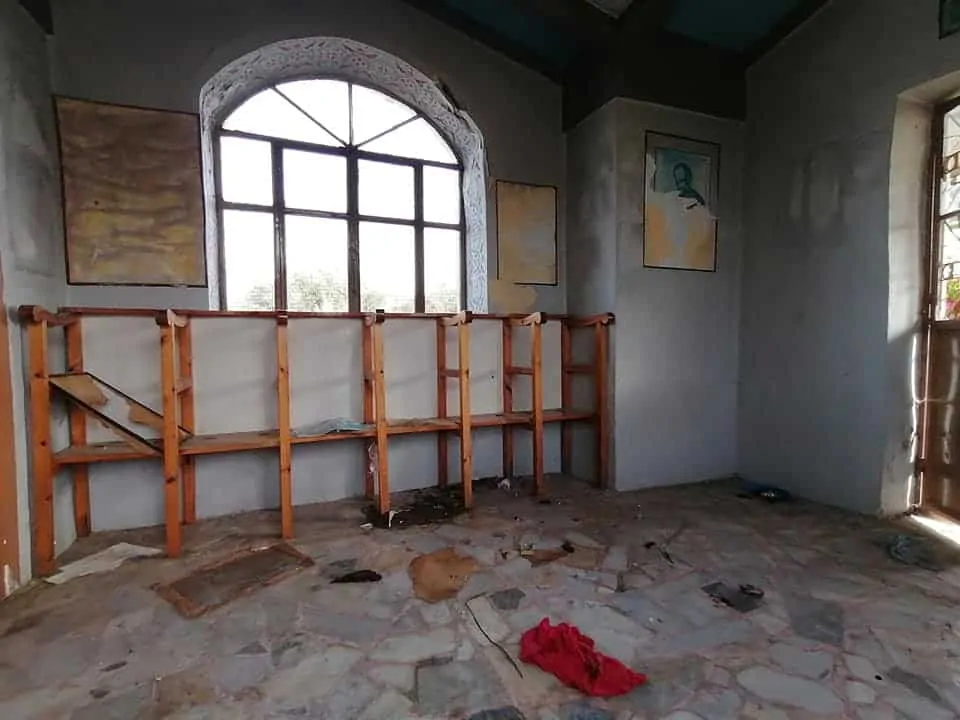
Trashed church on Lesvos becomes toilet for illegal immigrants

Trashed church on Lesvos becomes toilet for illegal immigrants 2

The Saint Catherine Church in the small town of Moria on Lesvos, is now being used as a bathroom.

A local in Moria described the scene.

“The smell inside is unbearable,” said Makis Pavlellis, a butcher. “Discussing with people about the Church, we learned that the metropolitan of Mytilene is aware of the situation in the area nevertheless he does not wish to deal with it for his own reasons.”

Only earlier this month Greek City Times reported that the Saint Catherine church in Moria was already trashed by illegal immigrants.

This is only the latest incident and rather it has become extremely common for Greek Orthodox Churches to be vandalised and attacked by illegal immigrants on Lesvos.

Last month, the main entrance to the Saint Raphael church close to the Moria migrant camp was attacked too, as reported by Greek City Times.

This latest incident on Lesvos follows other recent shocking events, including two gangs of Afghani immigrants battling each other, African immigrants ridiculing and coughing on police in the midst of the coronavirus pandemic, and thousands of olives trees being destroyed.

About half of the 50,000 illegal immigrants on Lesvos are kept at the Moria camp that is supposed to host only 3,000 people. A rise in criminality has hit the island since the migrant crisis began in 2015 when Turkey allowed hundreds of thousands of people to leave and enter Greece illegally, whether via land or sea.

Lesvos, as an island of only 90,000 citizens, has been one of the most hardest hit areas of Greece.

As a deeply religious society, these attacks on churches are shocking to the Greek people and calls to question whether these illegal immigrants seeking a new life in Europe are willing to integrate and conform to the norms and values of their new countries.

These continued attacks has ultimately seen the people of Lesvos, who were nominated for the Nobel Peace Prize in 2016, become increasingly frustrated by the unresolved situation that has restricted and changed their lives as they no longer feel safe on their once near crime-free island.

Meanwhile, Hungary has contributed $30,000 to assist in the restoration of Lesvian churches destroyed by illegal immigrants, as reported by Greek City Times.

greekcitytimes.com/2020/05/16/trashed-church-on-lesvos-becomes-toilet-for-illegal-immigrants/

Germany: Afghan man killed mother of three on the street yesterday

Horrible scenes unfolded during the night in Cottbus. An Afghan man (32 years old) killed his wife (28 years old) in the middle of the street. Witnesses had observed how the man “used massive violence” on the mother of his three children.The crime took place last Sunday night on a sidewalk in the middle of a housing estate. At 7:30 pm eyewitnesses called the police. They are said to have observed how the 32-year-old “used massive violence” on his wife, who is also from Afghanistan.A horrible suspicion: did the Afghan kill his wife with his bare hands? When asked about the murder weapon, the police remained silent for the time being. Whether a knife was involved, one could not yet say.For the mother of three children any rescue came too late. She died at the scene. The children aged 3, 6 and 10 years are now in the custody of the youth welfare office.

wochenblick.at/afghane-toetet-frau-auf-offener-strasse/

Germany Takes Back its Sovereignty from the European Union

Germany’s Constitutional Court has issued an unprecedented ruling that directly challenges the authority of both the European Central Bank and the European Court of Justice.

The seemingly obscure ruling, which seeks to reassert national sovereignty over bond purchases by the European Central Bank, has called into question the legitimacy of the EU’s supranational legal and political order.

The European Union is now engaged in a power struggle with its largest member state, Germany. The legal feud threatens to unravel not only Europe’s single currency, the euro, but the EU itself.

On May 5, the German Constitutional Court (Bundesverfassungsgericht, BVerfGruled that the European Central Bank’s practice of buying vast amounts of government bonds, a monetary policy known as quantitative easing, is illegal under German law as neither the German government nor the German parliament signs off on the purchases.

The European Central Bank has purchased government debt worth €2.7 trillion ($3.2 trillion) since March 2015, when, in an effort to stabilize the eurozone during the European sovereign debt crisis, it launched its flagship stimulus program, the so-called Public Sector Purchase Program.

The European Central Bank argues that large-scale purchases of government bonds are a monetary stimulus needed to reinvigorate the eurozone economy. Critics counter that the bond purchases have flooded markets with cheap money and encouraged over-spending by governments, especially in debt-ridden Southern Europe.

In a 110-page ruling, the German court said that the European Central Bank had not only failed to justify the massive bond purchases, but also that those purchases did not meet the “principle of proportionality,” as required by Article 5 of the Treaty on European Union.

The proportionality principle, which stipulates that an EU action must be limited to what is necessary to achieve an objective, regulates the exercise of the powers conferred by the member states to the EU.

In its ruling, the German court ordered the German Central Bank to stop participating in the bond-purchasing program unless the European Central Bank proves, within three months, the “proportionality” of its actions. Without German participation, the program could be terminated.

The German court also accused the Court of Justice of the European Union of “exceeding its judicial mandate.” In December 2018, the European court ruled in favor of the European Central Bank’s bond-purchasing program. The German court said that the European court’s ruling was ultra vires (beyond its authority) and therefore not binding. The German court’s ruling poses an unprecedented challenge to Court of Justice, the top EU court in matters of European Union law.

By design or default, the German court’s ruling, delivered at the height of the coronavirus pandemic, has created extraordinary financial, legal and political uncertainty at a time that Europe is already experiencing an economic shock without precedent.

Italy and Spain, the eurozone countries most impacted by the pandemic, are also the most dependent on support from the European Central Bank, which recently committed to purchasing an additional €750 billion in bonds. Economists warn that if the European Central Bank were to stop purchasing government bonds, the ensuing loss of liquidity could push Italy and Spain into default and lead to the unravelling of the eurozone.

The German court’s ruling marks a new phase in the debate over the balance between national and supranational sovereignty. Considering what is at stake, EU officials have pushed back hard. The President of the European Commission, Ursula von der Leyen, said that Germany has no legal right to challenge the EU and threatened a lawsuit:

“The recent ruling of the German Constitutional Court put under the spotlight two issues of the European Union: The Euro system and the European legal system.

“The European Commission upholds three basic principles: that the Union’s monetary policy is a matter of exclusive competence; that EU law has primacy over national law and that rulings of the European Court of Justice are binding on all national courts.

“The final word on EU law is always spoken in Luxembourg. Nowhere else.

“The European Commission’s task is to safeguard the proper functioning of the Euro system and the Union’s legal system.”

European Central Bank President Christine Lagarde echoed that she was undeterred by the German court:

“We are an independent institution, accountable to the European Parliament, driven by mandate. We’ll continue to do whatever is needed… to deliver on that mandate. Undeterred, we will continue doing so.”

In a press release, the European Court of Justice insisted that Germany has no jurisdiction:

“In general, it is recalled that the Court of Justice has consistently held that a judgment in which the Court gives a preliminary ruling is binding on the national court for the purposes of the decision to be given in the main proceedings. In order to ensure that EU law is applied uniformly, the Court of Justice alone — which was created for that purpose by the Member States — has jurisdiction to rule that an act of an EU institution is contrary to EU law. Divergences between courts of the Member States as to the validity of such acts would indeed be liable to place in jeopardy the unity of the EU legal order and to detract from legal certainty. Like other authorities of the Member States, national courts are required to ensure that EU law takes full effect. That is the only way of ensuring the equality of Member States in the Union they created.”

In an interview with the German newspaper, Frankfurter Allgemeine Zeitung, a member of the German Constitutional Court, Judge Peter Michael Huber, who helped write the ruling, responded:

“What amazes me is the one-sidedness and the zealous tone that is struck by some here. It is clear that the European Court of Justice has been claiming an unlimited precedence for European law for 50 years, but almost all national constitutional and supreme courts have objected to this for just as long. As long as we don’t live in a European superstate, a country’s membership is governed by its constitutional law.”

Huber warned that the European Commission’s threat of legal action would backfire:

“An infringement procedure [legal action] would trigger a significant escalation, which could plunge Germany and other member states into a constitutional conflict that would be difficult to resolve. In the long term, this would weaken or endanger the European Union.”

In an interview with Süddeutsche Zeitung, Huber added:

“From the point of view of the European Commission President von der Leyen, European law always applies without any restrictions. That is wrong. Other EU member states also assume that national constitutions take precedence over European law.

“The message to the ECB is actually homeopathic. It shouldn’t see itself as the ‘Master of the Universe.’ An institution like the European Central Bank, which is only thinly legitimized democratically, is only acceptable if it strictly adheres to the responsibilities assigned to it.”

Friedrich Merz, a member of German Chancellor Angela Merkel’s conservative Christian Democrats who is vying to succeed her as chancellor, said that the German court’s ruling will have far-reaching consequences:

“This judgment will make European legal history. It must be a special task of German economic policy in the future to point out the negative consequences of the European Central Bank’s purchase programs.”

The pro-EU columnist Martin Wolf, writing for the Financial Timesnoted:

“In the absence of other eurozone support programs, the chance of defaults has jumped. Indeed, spreads on Italian government bonds have duly risen a little since the court’s announcement. A crisis might ultimately ensue, with devastating effects; perhaps even a break-up of the eurozone.

“Others might follow Germany in rejecting the jurisdiction of the ECJ and EU. Hungary and Poland are obvious candidates. Future historians may mark this as the decisive turning point in Europe’s history, towards disintegration….

“One point is clear: The constitutional court has decreed that Germany, too, can take back control. As a result, it has created a possibly insoluble crisis.”

Writing for the influential German blog Tichys Einblick, Klaus-Peter Willsch, a member of the German parliament, wrote that the ruling demolished the absolutist claims to power of the European Commission, the European Central Bank and the European Court of Justice:

“One thing should never be forgotten: Europe is not a federal state, but a legal community developed from the founding core of an economic community in clearly limited areas of national sovereignty. Any sovereignty of the European Union is only derived from the sovereignty of the constituent member states. That is why Article 5 (2) of the Treaty on European Union states:

‘Under the principle of conferral, the Union shall act only within the limits of the competences conferred upon it by the Member States in the Treaties to attain the objectives set out therein. Competences not conferred upon the Union in the Treaties remain with the Member States.’

“I therefore think that criticism of the decision of the top German judges is not only inappropriate, but also completely unfounded.

“Last week, our constitutional court defended the interests of German citizens. It reminded the European Central Bank and the European Court of Justice of the limits of the applicable law. Now it is up to us in politics gratefully to accept and implement the decision of the Federal Constitutional Court instead of disparaging our constitutional judges as enemies of Europe! The German constitutional state lives and it protects its citizens! We should all be happy about that!”

https://www.gatestoneinstitute.org/16031/germany-sovereignty-eu

Dutch asylum-seekers break crime record

Dutch State Secretary Ankie Broekers-Knol announced the annual crime data to the House of Representatives, and to no one’s surprise, asylum-seekers were revealed to be massively involved in crime.

In the past year they were more often involved in nefarious activities than the previous year. The increase in 2019 compared with 2018 is no less than 27 percent, Broekers-Knol told the Tweede Kamer.

Within AZCs [asylum reception centers], more than 17 000 crimes were committed, and almost 5 000 outside AZCs, according to Dutch daily, De Dagelijkse Standaard. This not only concerns thefts and burglaries, but also several dozen sexual crimes and two murders.

These numbers are worrisome, given that the total number of asylum-seekers has declined in the past few years. The current cabinet has thus been failing miserably with its policy of asylum and migration.

The VVD has been maintaining for years that they favor a strict quick-response policy, but in fact law enforcement never dare to follow through, unfortunately. Incidents have allegedly been recorded more accurately, they maintain.

The Cabinet is commissioning additional research into the increases in the number of incidents to obtain a “scientific” explanation since a number of reception locations have been closed, resulting in an increase in the occupancy rate at those locations.

The crime data among asylum-seekers are increasing because more and more asylum-seekers come to the Netherlands who have really no chance of gaining asylum since they come from “safe countries” like Morocco, Algeria and Nigeria. Within the walls of shelters crimes are often about “aggression and violence” against persons. And in almost a third of the cases reported, it concerns persons from these countries.

State Secretary Broekers-Knol has promised that she will be taking hard measures. She said that a special reception location for such migrants will be opened in Hoogeveen where they are no longer allowed to leave the site without permission. However, there is limited space for only 50 people.

Theo Hiddema is a Dutch lawyer and a member of the Tweede Kamer for Thierry Baudet’s party Forum for Democracy. Hiddema has outlined the solution to the problem of migrant crime in the Netherlands.

“It won’t end until I’ve taken [State Secretary for Security and Justice] Broekers-Knol’s position. There’s no hope for her,” Hiddema told Dutch public media.

He said the Rutte administration offered no solutions.”It’s the same pattern over and over again. Somebody is accepted as a refugee, even though his first contact with the authorities […] indicates we’re dealing with an antisocial personality.

“That goes for all those ‘confused types’ who were accepted as refugees. They’re antisocial personalities. They don’t have a solid refugee story. They’re just here to check out how society here works… and leech off it. That’s it. And such people, as soon as they violate the law, you have to lock them up immediately.”

He said all criminal asylum seekers should be forced to seek self-deportation by means of detention. “It’s really simple: you have to put them in ‘temporary detention’. And then wait for them to say: ‘I want to go back to my country’.

“Because if they want to return, there’s no problem whatsoever. That goes for Morocco too, for Algeria. Sudan won’t be any different; it’ll be a bit easier, I think.”

Hiddema explained that the asylum seeker who is locked up in detention will rather take the initiative and leave. “Will I stay under lock and key, or do I go out the door?”

He said such people would choose to leave of their own free will. “Even though they’re involved in a criminal case, if they say they want to leave, there’s no problem, because you suspend the temporary detention, and you retract the subpoena or declaration of prosecution. That’s it.”

He explained the process: “Then there’s no criminal case and he can board the plane just like that. But you have to detain them after they committed a crime for which temporary detention can be imposed. Simply because of the likelihood of a repeat offense. And a flight risk!”

freewestmedia.com/2020/05/18/dutch-asylum-seekers-break-crime-record/

Statistics Denmark: Two women raped every single day

Newly released figures from the Danish government have revealed that rapes are more prevalent than  ever before in the country’s history.

Statistics Denmark, a governmental agency that’s responsible for producing statistics on Danish society, recently released figures which revealed that a total of 290 women reported having been raped in the first quarter of 2020. That amounts to more than two raped women every day, Den Korte Avis reports.

To put the figures into perspective, the number of rapes reported in the first quarter of 2014 totaled 87. So, between 2014 and 2020 rapes in Denmark have skyrocketed by an alarming 333 percent.

Unfortunately, the vast majority of rape cases are never solved. However, data which has been extracted from the cases that police do solve has shown that non-Western migrants are vastly overrepresented in rape convictions. For example, in 2018, a total of 69 men were convicted of rape, and of those, almost half (30) were of non-Western origin.

It should be noted that non-Western immigrants make roughly 4.4 percent of the total percentage of Denmark’s population.

Migrants living in Sweden are also vastly overrepresented in rape crime. In 2018, Swedish broadcaster SVT reported on a study which revealed that 58 percent of convicted rapists in Sweden were foreign born. As of 2017, foreign born individuals made up roughly 18 percent of the total Swedish population.

voiceofeurope.com/2020/05/statistics-denmark-two-women-raped-every-single-day/

Muslim double murderer in Austria mocks his victims and claims: “Only Allah can judge me!”

Photo: Landespolizeidirektion Oberösterreich

Jamal A.,(photo) the allegedly Afghan-born double murderer of Wullowitz, is said to be mocking his victims, an aid worker for asylum seekers and a farmer, according to media reports in prison. He would have no regrets. And only Allah could judge him.

The 33-year-old Afghan had slit the throat of a 32-year-old Red Cross helper. “In revenge”, as he had now expressed it. Allegedly David N. had arranged that he was no longer allowed to work in the old clothes collection of the community. His first victim lost the fight for his life after a few days in hospital.On the run, Jamal A. passed a farmhouse. There he murdered the old farmer Franz G. The newspaper Heute quoted the suspected double murderer with the words that the farmer had not been willing to give him his car. This was his death sentence. Somehow he thought it was “not good” that the two people had to die because of him, but “they have only themselves to blame for their death”. He would have no regrets. He would be in daily contact with Allah and only Allah could judge him. A. is defended by the “star lawyer” Astrid Wagner, who has represented many Muslim criminals, such as the Graz amok driver Alen R. in court. Very worth seeing in this context is also Stefan Magnet’s highly acclaimed video from 21st of October. It was about the threat of legal action by lawyer Astrid Wagner against everyone who calls her Muslim client a “murderer”.

wochenblick.at/wullowitz-moerder-nur-allah-kann-ueber-mich-richten/

Thousands demonstrate in Germany against confinement

Thousands of Germans demonstrated nationwide again this weekend against Corona confinement requirements. Citizens who are afraid for their jobs, rallied alongside extremists and opponents of vaccination.

In many cities, people took to the streets against the imposed Corona rules on Saturday, German daily Die Welt reported. In Berlin, a thousand police officers secured the protests, and in Munich police carried protesters away since many did not wear a mask nor kept their distances.

Several thousand people gathered in Berlin-Mitte on Saturday afternoon for various demonstrations.

At the Alexanderplatz alone, four rallies were held at the same time, surrounded by police officers. Officials made sure that there were no more than 50 demonstrators at a time. The distance of 1,50 meters was also maintained.

In the middle of the square, more than 40 demonstrators protested with banners and a loudspeaker for the rights of refugees. A few meters away, dozens of people demonstrated with loud music against confinement and vaccinations.

Several hundred people gathered in front of the Reichstag building to attend a rally by Turkish-born television chef Attila Hildmann against the Corona restrictions.

On Saturday afternoon, far more than the permitted 1 000 people came to Theresienwiese in Munich to demonstrate against the conditions imposed during the Corona crisis. After the cordoned off area was filled, the police sent the waiting people away. Hundreds then lined the sidewalks along the area where the Oktoberfest is otherwise celebrated in autumn.

Announcements by the police to leave the area around the cordoned off space, were met with boos from the demonstrators. The organisers plan to demonstrate with 10 000 participants next week.

As announced, the police were on site with a large contingent – on foot and on horseback. The Munich Presidium spokesman, Marcus da Gloria Martins, said shortly before the start that the participants had very different intentions. State security will be looking at whether people with extreme right-wing aspirations were also present, he said.

In Dresden, some protesters denied the existence of the virus and accused politicians of just wanting to scare them with a “Corona lie”while others expressed concern about a mandatory vaccination requirement.

Several hundred people demonstrated in Hamburg against “supporters of conspiracy theories”. They fought verbally and fought with demonstrators who protested the state protection measures. At least one person was slightly injured in a clash, the police confirmed.

Several people were detained, a police spokesman said.

A higher-level employee of the ministry, identified in the media as Stephan K, released a report last Friday strongly critical of the German government’s response to the Coronavirus crisis.  In an 83-page document he sent to federal and state government officials he claims the collateral damage of Germany’s lockdown measures has outweighed the threat of the virus and likely resulted in more deaths than from Covid-19 due to the cancellations of surgeries at hospitals nationwide.

According to the police, a ZDF camera team was pressured in Halle in Saxony-Anhalt at a rally against the Corona measures. The ZDF team later left the market place under police protection. Nobody was injured.

Thousands of people gathered again in Stuttgart for a demonstration against the Corona restrictions. This time, however, only 5 000 participants were allowed on the Cannstatter Wasen, which is why numerous people came together outside of the designated area. The police assigned them another area.

According to police, several hundred people also demonstrated in Rhineland-Palatinate and Saarland. A demonstration against the Corona restrictions planned for Saturday afternoon in Koblenz was banned by the Koblenz Ordnungsamt after a previous demonstration had violated the mouthguard and distance requirements.

Two demonstrations with 50 and 100 participants took place in Dortmund, which, according to the police, was peaceful. Around 300 people demonstrated in Düsseldorf at three different locations against various Corona measures.

In Aachen, several demonstrations were announced for the afternoon, including a larger one from the AfD, in which around 100 participants were expected. In Essen, 230 people demonstrated in a parking lot on the outskirts of the city. There were no incidents, said a police spokesman.

freewestmedia.com/2020/05/18/thousands-demonstrate-in-germany-against-confinement/